Kloudfuse Security
Kloudfuse is a unified observability platform, designed for modern, cloud-native environments. It provides deep, correlated insights across all telemetry types — metrics, logs, traces, and events — through a high-performance architecture.
Kloudfuse delivers a secure, scalable, and high-performance observability solution for enterprises. Its unique architecture ensures data privacy while offering enterprise-grade security features across identity, data, and operations.
This document outlines the key security features and practices of the Kloudfuse platform.
Platform Architecture and Deployment Model
Kloudfuse employs a hybrid deployment model:
Platform architecture enables Kloudfuse customers to retain full control over their data, while benefiting from SaaS-like operational ease.
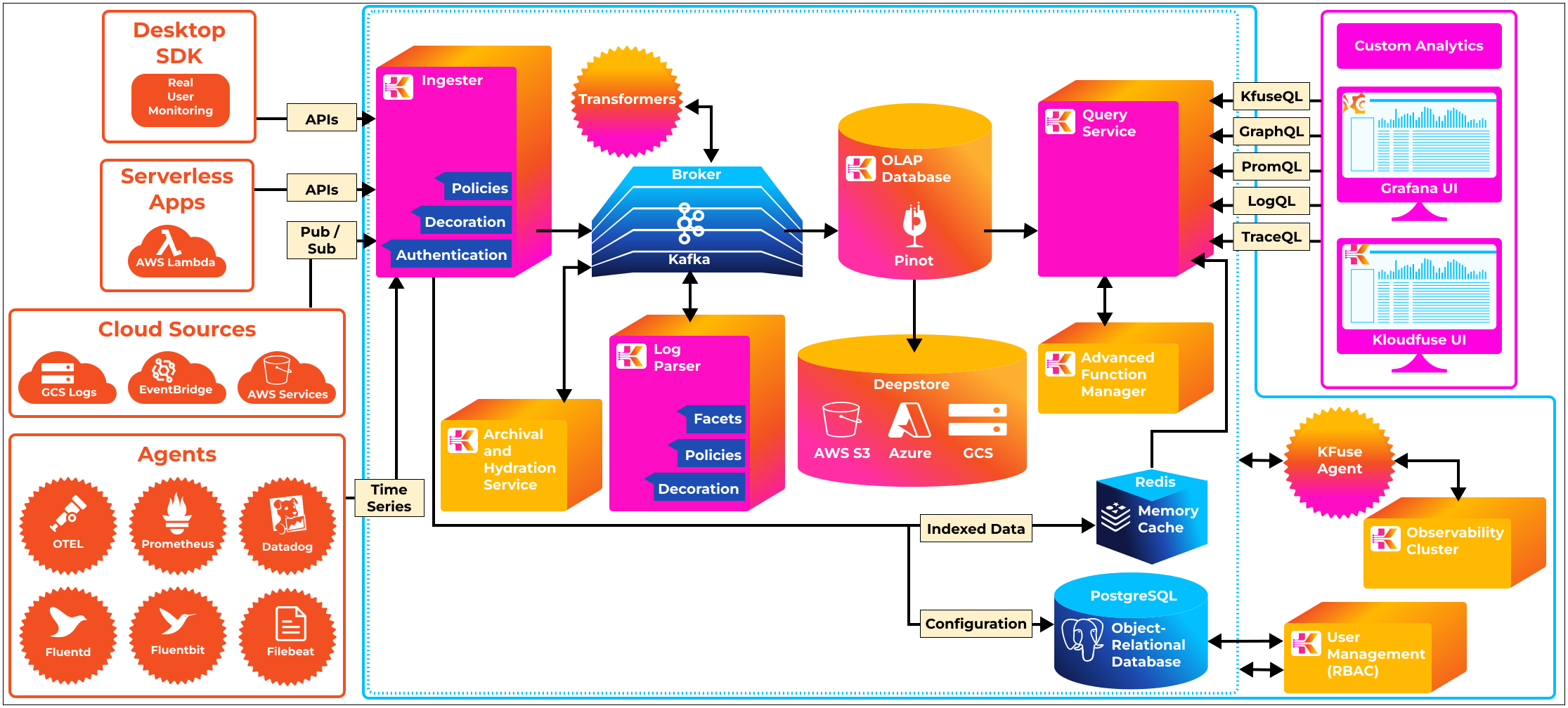
Infrastructure and Physical Security
Because the data plane resides within the customer’s cloud infrastructure (AWS, Azure, GCP), the customer and their cloud provider manage the physical and infrastructure-level security. This approach ensures high level of security and alignment with industry standards.
Identity and Access Management
- Role-Based Access Control (RBAC)
-
Every user holds one of three roles — Admin, Editor, or Viewer — which sets what they can create, edit, and administer. Roles can be assigned manually or synchronized from your identity provider’s groups. See Role-Based Access Control.
- Data Access Policies
-
Policies define which telemetry streams an identity may query — Metrics, Events, Logs, Traces, APM, and RUM — each set to All, None, or Filtered by label. A policy attaches to a team, an individual user, or a service account, and resolves to a label filter that is applied to every query before it reaches the data layer. Editors and Viewers are governed by their policy, and
default_rbac_policy: rbac_allow_nonedenies data to any of them who has no policy assigned; the Admin role is evaluated first and always receives full data access, so it should be held by platform administrators only. See RBAC Policy Management. - Folder Permissions
-
Dashboards and alerts live in folders, each granting View, Edit, Admin, or No Access to users, teams, roles, and service accounts independently of the data policy. See Folder Permissions.
- SSO/SAML Integration
-
Enterprise authentication through SAML, Google, Okta, JumpCloud, or any OIDC provider, with the option to disable local logins entirely. See Kloudfuse Authentication Introduction.
- Ingest Authentication
-
Ingest endpoints can require an API key, sent as the
Kf-Api-Keyheader or in the agent’s native API-key field. UI-managed keys are stored only as a SHA-256 hash, may carry an expiry, support several live tokens for rotation without downtime, and can attach labels to the data they admit — which the policies above can then filter on. See Ingestion Authentication with API Key.
Auditability
- Audit Logs
-
Record authentication events and changes to users, groups, service accounts, policies, and folder permissions — who changed what, and when. They are a first-class log stream, so they are queryable in the product and can be archived alongside other logs. See Enable Audit and Performance Logs.
- Performance Logs
-
Record every query the platform executes, the query service that served it, and its duration, attributed to the requesting user for UI and service-account queries; internal service-to-service calls and alert evaluations carry no user. Together with audit logs they record both changes to the platform and reads of the data in it. See Performance Log Fields.
Data Security
- Data Residency
-
All telemetry data resides in the customer’s cloud account.
- Redaction Before Ingest
-
The Datadog Agent and the OpenTelemetry Collector can both mask matched card numbers, credentials, and other sensitive values before telemetry leaves your network, reducing the regulated data that reaches the platform. See Keeping Sensitive Data Out of Kloudfuse.
- Card Data Detection
-
FuseQL’s
luhnpredicate validates card-number checksums in query, so a scheduled search can detect card-shaped values in log bodies that slipped past collector masking. See Detect What Got Through. - Log Classification and Handling
-
Ingests various log types (application, security, system, network) with flexible parsing and indexing.
- Log Archiving and Hydration
-
Rule-based archival of logs to object storage with on-demand retrieval. Archiving the audit log stream gives a retained copy outside the query store. See Archiving Logs and Hydration.
- Data Scrubbing
-
Permanent deletion of stored metrics, events, logs, and traces by filter, for retention and right-to-erasure obligations. See Data Scrubbing.
Vulnerability and Patch Management
- Regular Release Cycles
-
Address CVEs and apply security patches.
Customers can monitor updates through our Release Notes.
Software Supply Chain
- Signed Container Images
-
All Kloudfuse container images in AWS ECR are signed with cosign using an AWS KMS key; the private key never leaves KMS, and signatures are stored as OCI artifacts alongside the image. Verify signatures before deployment with the public key or directly against KMS. See Verify Image Signatures.
- Verification in CI/CD
-
Pipelines can pull and verify images with short-lived OIDC credentials instead of stored AWS keys. See Audit Images from ECR.
- FIPS Builds
-
The FedRAMP chart is built for FIPS-compliant environments (FedRAMP Installation), and a FIPS build of the Envoy gateway is published for deployments that require it (Standalone Envoy Gateway).
Compliance and Certifications
- FedRAMP-Aligned Deployment
-
The
kfuse-fedchart deploys Kloudfuse on AWS with managed RDS, ElastiCache, and MSK in place of bundled in-cluster services, and encrypts all persistent data with customer-managed KMS keys to satisfy the NIST SP 800-53 SC-28 control family required by the FedRAMP High and Moderate baselines. See FedRAMP Installation and EBS Volume Encryption (FedRAMP). - Regulated Data
-
For PCI DSS, HIPAA, GDPR, and similar frameworks, regulated data is masked before it reaches the platform, access to what arrives follows least privilege, and changes and queries are logged. The controls behind each of those are described above; the customer-facing guide is Keeping Sensitive Data Out of Kloudfuse.