Query Interleaving
Overview
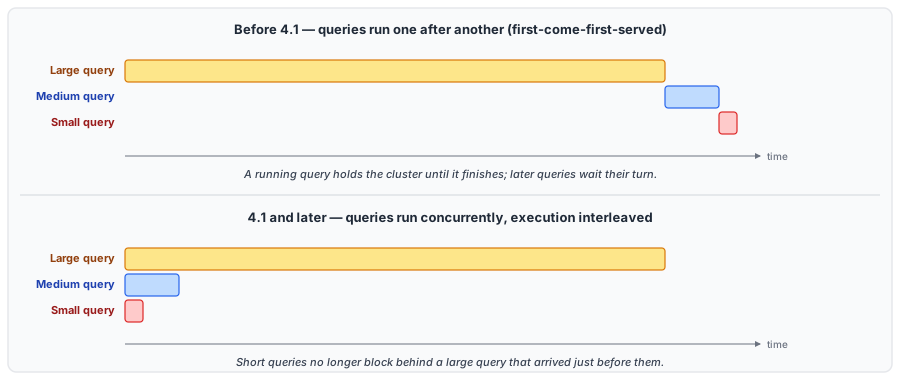
Query interleaving lets Kloudfuse run multiple Pinot queries concurrently and interleave their execution, so a small interactive query is not held up by a large query that arrived just before it.
Before 4.1, Kloudfuse processed Pinot queries first-come-first-served: a query that started running held the cluster until it finished, and any queries that arrived after it had to wait their turn. With query interleaving, queries that arrive at roughly the same time make progress together — short queries finish quickly while long queries continue to run in the background.
When query interleaving is enabled and query priorities are configured, higher-priority queries also receive a larger share of cluster capacity. See Query Priorities for how priorities are assigned and resolved.
Query interleaving shipped enabled by default in Kloudfuse 4.1. Starting in Kloudfuse 4.2.4, it is disabled by default and must be explicitly enabled per cluster from custom_values.yaml; see Enable Query Interleaving.
Enable Query Interleaving
To enable query interleaving on Kloudfuse 4.2.4 or later, select the segment-level scheduler in your Helm custom_values.yaml and reapply the chart:
global:
  queryScheduler:
name: segment_levelEnabling query interleaving also activates the High / Medium / Low scheduler priorities described in Query Priorities. Without it, only the Blocked priority takes effect — see The Blocked Sentinel.
Disable Query Interleaving
On Kloudfuse 4.2.4 and later, query interleaving is off unless you enable it. To disable it again, remove the global.queryScheduler.name setting from custom_values.yaml and reapply the chart.
On Kloudfuse 4.1 through 4.2.3, where interleaving is enabled by default, revert to the previous first-come-first-served behavior — for example, while triaging an issue or comparing behavior — by setting the following in your Helm custom_values.yaml and reapplying the chart:
global:
  queryScheduler:
enabled: falseWith the scheduler disabled, queries fall back to the pre-4.1 sequential execution model.